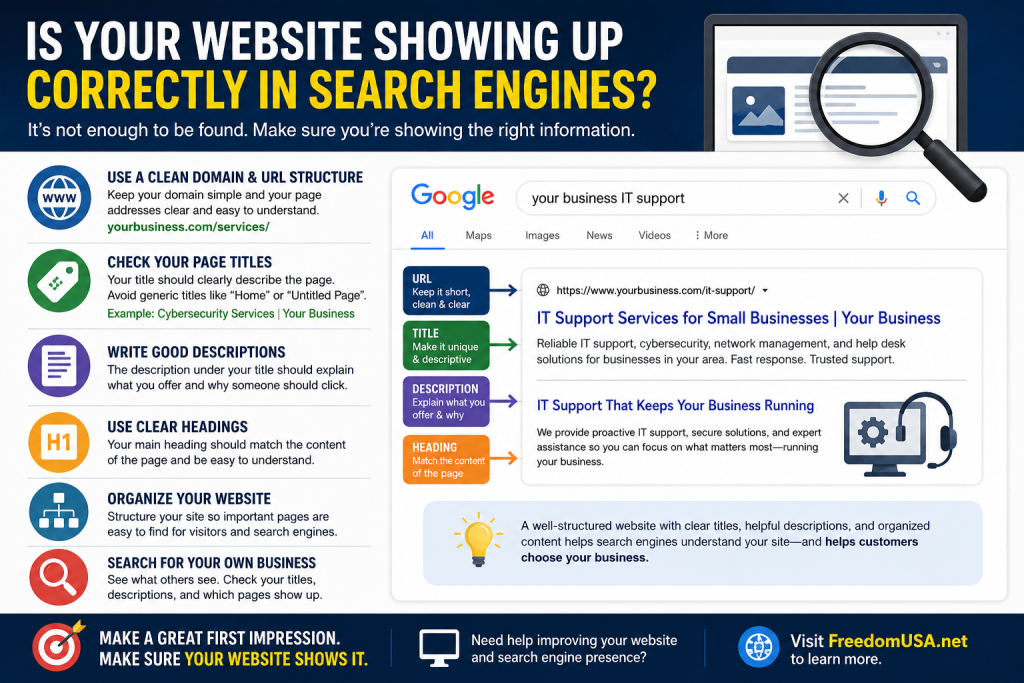
Your website may be listed in Google and other search engines — but are they showing the right information?
Many business owners search for their company online, see their website in the results, and assume everything is working correctly.
But appearing in a search engine is only part of the job.
Your domain structure, page addresses, titles, descriptions, and website organization can affect how search engines understand your site — and how potential customers see your business.
1. Make Sure You Are Using the Correct Domain Structure
Your website should have one clear and consistent domain structure.
For example:
yourbusiness.com
Your pages should also have simple, understandable addresses:
yourbusiness.com/services/
yourbusiness.com/phone-systems/
yourbusiness.com/cybersecurity/
yourbusiness.com/contact/
Avoid unnecessarily complicated addresses such as:
yourbusiness.com/page.php?id=472&category=12
A visitor should be able to look at a web address and have a reasonable idea of what the page is about.
Your website should also consistently use the secure HTTPS version of your domain.
2. Check the Title Showing in Search Results
Search for your business and look carefully at the title displayed by the search engine.
Does it properly describe the page?
For example:
Business Phone Systems | ABC Company
is much more useful than:
Home
Welcome
Page 1
Untitled Page
Each important page of your website should have a descriptive title that explains what visitors will find there.
For example:
Cybersecurity Services for Small Businesses | ABC Company
Computer Repair & IT Support | ABC Company
Commercial Networking Solutions | ABC Company
The title helps search engines and potential customers understand the purpose of the page.
3. Make Sure the Correct Page Appears
Suppose someone searches for:
ABC Company cybersecurity
Ideally, the search engine should display the company’s cybersecurity page — not simply the homepage.
The same applies to other services.
Someone searching for your phone systems should find your phone-system page.
Someone searching for web hosting should find your web-hosting page.
Someone looking for IT support should be directed toward the page explaining your IT services.
This is one reason having a separate, well-designed page for each major service can be important.
4. Check Your Main Page Heading
Your main heading should clearly explain what the page is about.
Instead of:
Welcome to Our Website
consider:
Business IT Support and Computer Services
Instead of:
Our Solutions
consider:
Cybersecurity Solutions for Small Businesses
Clear headings help visitors immediately understand where they are and reinforce the subject of the page.
5. Look at the Description Under Your Search Result
Search engines often display a short description underneath the page title.
Look at yours.
Does it clearly explain your business or service?
A useful description might read:
ABC Company provides computer repair, network installation, cybersecurity, cloud services, and technical support for businesses throughout the local area.
Compare that with:
Welcome to our website. Click here to learn more about us.
Which one would you be more likely to click?
Your search listing is a small advertisement for your website. Make it meaningful.
6. Don’t Give Every Page the Same Title
This is a surprisingly common problem.
A business might have 20 pages, but every page is simply titled:
ABC Company
That doesn’t tell a search engine — or a potential customer — what each page contains.
A better structure would be:
Computer Repair | ABC Company
Cybersecurity Services | ABC Company
Business Phone Systems | ABC Company
Network Installation | ABC Company
Web Hosting | ABC Company
Now every page has a clear purpose while still identifying the business.
7. Search for Your Own Business
Every business owner should occasionally look at their company the same way a potential customer would.
Try searching for:
Your company name
Your company name + city
Your company name + service
Service + city
Then examine the results.
Ask yourself:
- Does the correct website appear?
- Is my company name displayed correctly?
- Are my page titles accurate?
- Does the correct service page appear?
- Does the description make sense?
- Are old pages appearing that should no longer be there?
- Would I click this result if I were a customer?
These simple checks can reveal problems that may otherwise go unnoticed.
Your Search Result Is Your Digital Storefront
Before someone calls your company, visits your location, or even opens your website, they may see your business in a search engine.
That search result is part of your first impression.
Your domain, URLs, page titles, headings, descriptions, and content should all clearly communicate:
Who you are.
What you do.
Where you provide your services.
And most importantly:
Why someone should visit your website.
Don’t just ask:
“Is my website on Google?”
Ask:
“When someone finds my business, are they seeing the information I want them to see?”
Need Help With Your Website’s Search Engine Presence?
FreedomUSA Technologies helps businesses review their websites, improve website structure, identify search-engine presentation problems, and create a clearer online presence.
If you’re unsure what customers are seeing when they search for your business, it may be time for a website and search-engine review.
FreedomUSA Technologies
Technology is Freedom.
850-900-3006
Visit FreedomUSA.net to learn more.