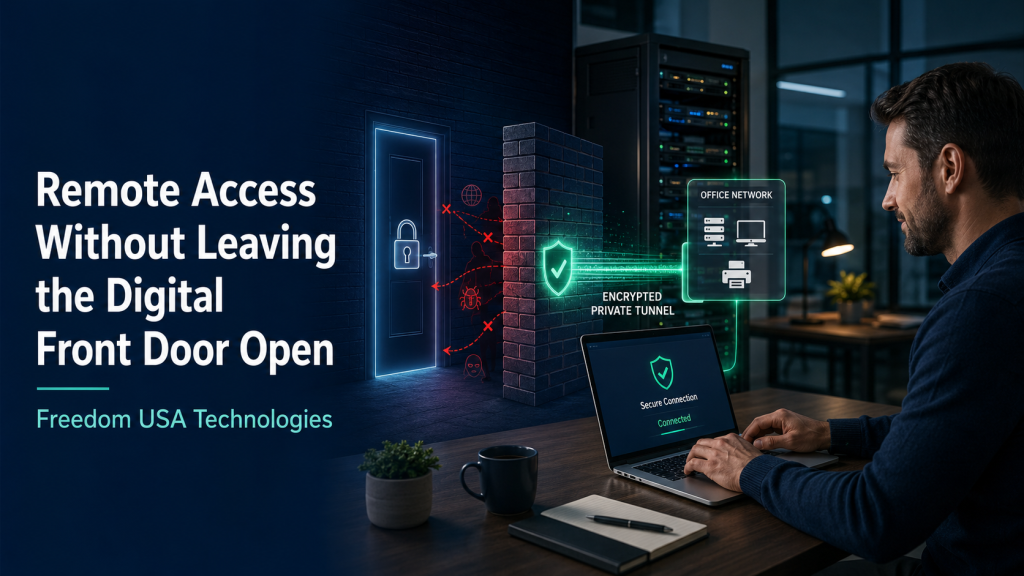
Cloud technology has changed the way people work. Files, applications, cameras, telephone systems, servers and business tools can now be reached from almost anywhere.
However, many companies have not updated the way they provide remote access. They may have modern cloud services in one part of the business while still depending on an older remote-access server, an exposed login page or an open firewall port to reach important systems.
That combination can create a serious security risk.
Remote access is not the problem. Businesses need it. The real question is how that remote access is provided and who is allowed to find it.
Why Businesses Need Remote Access
Remote access allows an authorized person to use a computer, server or other device without being physically present at its location.
It can help a business owner check office files from home, allow an employee to work while traveling, let a technician maintain a server, or connect two offices so they can safely share resources.
Remote access can save time, reduce travel and keep a business operating during an emergency. It has become an essential part of modern business.
But convenience without proper security can leave an opening for attackers.
The Problem With Internet-Facing Remote Access
A traditional setup may place a remote desktop service, server or login page directly on the public internet. The firewall allows incoming connections through a particular digital doorway, commonly called a port.
The business needs that doorway so its employees can connect. Unfortunately, attackers can often discover that the doorway too.
Automated systems continuously scan the internet looking for exposed services. Once they find one, attackers may try stolen passwords, common passwords, software weaknesses or repeated login attempts. They do not necessarily need to know the business personally. The scanning and attacks can happen automatically.
The U.S. Cybersecurity and Infrastructure Security Agency advises organizations not to expose services such as Remote Desktop Protocol directly to the web. CISA also warns that exposed and poorly secured remote services are a common way criminals gain initial access before spreading ransomware. (CISA StopRansomware Guide)
A firewall is still important, but opening a firewall rule for a public remote-access service means that some internet traffic must be allowed to reach it. The system then depends heavily on passwords, updates and the security of the exposed software.
A Private Tunnel Takes a Different Approach
FreedomUSA Technologies specializes in creating private, encrypted connections between approved devices and networks.
You can think of the public internet as a large highway. An ordinary internet-facing remote server places a visible entrance along that highway. Anyone passing by may be able to see the entrance and attempt to reach its door.
A private tunnel works differently. Approved devices establish an encrypted path and communicate through that protected connection. The remote computer or server does not need to advertise its normal remote-access service directly to the entire internet.
The tunnel does not literally travel underneath the firewall. Instead, it is created through carefully controlled firewall and security rules. The firewall remains part of the protection.
Once the connection is established, approved devices can communicate as though they are part of a private network—even if they are in different buildings, cities or states.
What Makes the Connection More Private?
A properly designed private-access system can provide several layers of protection:
- The remote desktop or business service is not exposed directly to the public internet.
- Only approved users and devices receive permission to join the private network.
- Information traveling through the tunnel is encrypted.
- Access can be limited to the particular systems each person needs.
- A lost, stolen or retired device can have its permission removed.
- Activity can be monitored and reviewed.
- Multi-factor authentication can add another identity check.
This approach greatly reduces the number of people and devices that can even attempt to reach the protected service.
It follows an important modern security principle: access should be granted according to identity, device and need—not simply because something is connected to a particular network. The National Institute of Standards and Technology describes this as part of a “zero trust” approach, in which trust is not automatically granted based only on network location. (NIST Zero Trust Architecture)
Connecting Two Business Locations
Private tunnels can also securely connect entire networks.
For example, imagine a business with a main office and a second location. Each building has its own internet service and local network. Instead of placing a file server or business application directly on the public internet, FreedomUSA can create a controlled tunnel between the two locations.
Approved systems at the second location can then reach selected resources at the main office through the encrypted connection.
The same approach can connect:
- A home office and a business office
- Two business locations
- A cloud server and an office network
- An authorized technician and a customer’s equipment
- Remote employees and specific company resources
- Security cameras or other managed devices when properly configured
The important word is specific. Good remote-access security does not automatically give every connected person access to everything. Each person or device should receive only the access required to do its job.
No System Is Completely Impossible to Hack
No responsible technology company should promise that any system is completely unhackable.
A private tunnel reduces exposure, but security still depends on the complete environment. Computers must be updated. Accounts need strong passwords. Multi-factor authentication should be used when available. Lost devices must be removed. Employees should be cautious about phishing emails and fraudulent login pages. Important information should be backed up.
Security is strongest when several protections work together.
The goal is not to claim that risk has disappeared. The goal is to remove unnecessary public exposure, strictly control access and make an attack substantially more difficult.
Cloud Technology Does Not Automatically Mean Better Security
Moving a service to the cloud can offer flexibility, backup options and easier access. But the word “cloud” does not automatically make a system secure.
A cloud server with an exposed remote-access port can face many of the same risks as a server inside an office. Security still requires good configuration, controlled access, updates, monitoring and responsible users.
Modernizing a business is not simply moving everything online. It means choosing a safer way for people, devices, offices and cloud systems to communicate.
Security Without the Technical Confusion
Many small businesses know they need remote access but do not have a full-time security department. They may also feel overwhelmed by technical terms and complicated product choices.
FreedomUSA Technologies focuses on making secure remote access easier to understand and use.
We evaluate what needs to connect, who should have access and what should remain private. We then build a controlled connection around the customer’s actual needs. We can also help configure devices, remove access when an employee leaves, and provide personal technical support.
Customers do not need to understand every networking term. They need to know that their authorized people can reach the systems they need—without unnecessarily presenting those systems to the rest of the internet.
Is Your Remote Access Exposed?
If your business uses remote desktop, a remote-access server, a public login address or open firewall ports, it may be time for a security review.
Ask these questions:
- Is our remote-access service visible from the public internet?
- Do we know exactly which users and devices have access?
- Can access be removed quickly from a lost device or former employee?
- Are we using strong passwords and multi-factor authentication?
- Can remote users reach more of the network than they actually need?
- Are our computers, servers and remote-access tools fully updated?
- Do we have current backups if ransomware reaches the network?
Remote work and cloud services are not going away. Businesses should be able to use them without leaving the digital front door unnecessarily exposed.
FreedomUSA Technologies helps connect approved people and networks through private, encrypted tunnels—providing the access a business needs with fewer services exposed to the public internet.